
Frontier, Sold Separately
Microsoft turned the "Frontier Firm" into a product line this month. The judgment to run one isn't included.


Microsoft opened the Houston stop of its AI Tour by leaning into the city itself — space, energy, medicine. Three frontiers Houston is known for.
Fitting, because the phrase I heard most that day was “Frontier Firm.”
I wrote a short explainer about the concept on LinkedIn after the event. This is the longer version — the part that didn’t fit in a post, and the part this month’s headlines keep underlining.
The pitch
If you haven’t sat through a session on it yet, the Frontier Firm is Microsoft’s name for an organization that fuses human expertise with AI agents so tightly that outcomes start to matter more than the org chart. Intelligence becomes something you tap on demand. Work gets organized around what needs to happen, not who sits where.
They frame the journey in three phases:
Assistants — every person has AI that understands their role and supports their work.
Collaborators — every team manages agents that complete tasks on their own.
Orchestrators — every organization directs fleets of agents that run enterprise activities, with people setting direction and checking in.
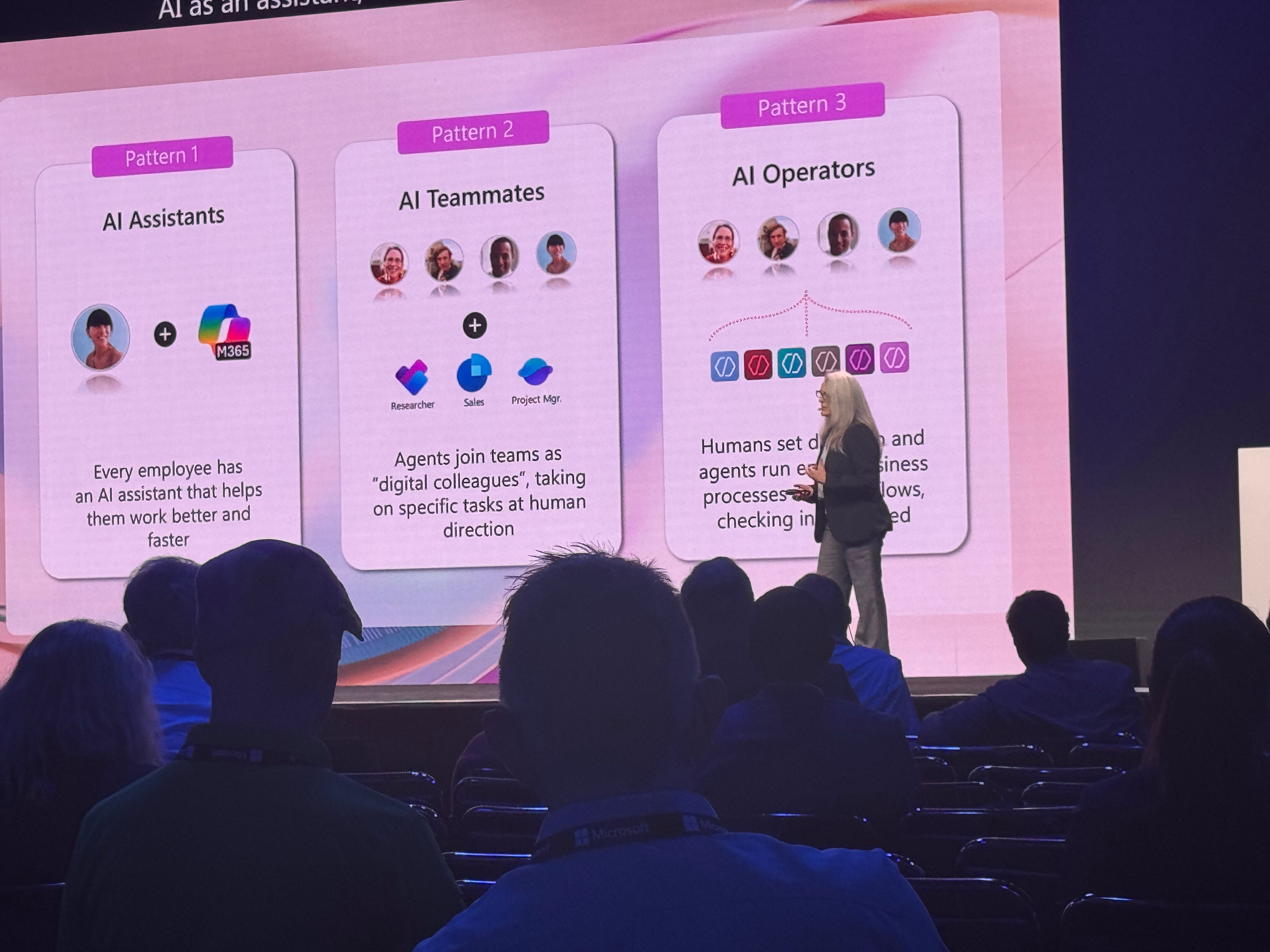
On stage, the whole shift got boiled down to two words: intelligence and trust. And it wasn’t pitched as theory — one slide stacked company after company reporting hours saved and capacity expanded, with 87% of leaders saying they’re confident agents will help them do more with what they already have.
It’s a genuinely compelling vision. I want to be clear about that before I complicate it.
The frontier got productized
Here’s what’s happened since I flew home.
On June 9, KPMG and Microsoft announced that KPMG will deploy Agent 365 — Microsoft’s control plane for managing, monitoring, and securing AI agents — across its global organization, while rolling out Copilot to its entire workforce and helping clients do the same.
Read that announcement next to the Houston keynote and you see the move clearly. The Frontier Firm is no longer an aspirational slide. It’s a SKU. There is now a product whose entire job is to manage your fleet of agents — which tells you the vendors have stopped debating whether enterprises will run agent fleets and started competing over who gets to operate the harbor.
And it’s not just Microsoft. Scan this month’s enterprise announcements and every major platform — cloud providers, consulting firms, data platforms — is now describing agents in nearly identical terms: goals, memory, planning, autonomy. When the whole market converges on one vocabulary, that’s not marketing coincidence. That’s market structure forming.
The frontier, in other words, is getting crowded. Fast.
The other number
Now hold the 87% confidence stat from Houston next to a different number.
WRITER’s 2026 enterprise adoption survey — 1,200 executives, 1,200 employees — found that 79% of organizations are struggling with AI adoption, up double digits from last year. More than half of C-suite executives said, in their own words, that adopting AI is tearing their company apart. This while 97% report deploying agents in the past twelve months.
Both numbers are true at the same time. Leaders are confident in what agents can do, and organizations are straining under what agents require.
That’s not a contradiction. That’s the gap between buying the destination and surviving the trip.
Because here’s what the three-phase journey quietly assumes at every step: people who can direct an agent, evaluate what it hands back, and know when the answer is wrong. Phase one assumes everyone can work with AI. Phase two assumes every team can manage it. Phase three assumes the whole organization can govern it. Each phase is a bigger bet on human judgment, not a smaller one.
The vendors are scaling the agents. Nobody scales the judgment for you.
The question on the screen
The line that stuck with me from Houston wasn’t a stat. It was a question left up on the screen at the end of a session:
If you were building your business with AI today, what would you do differently?
I think it’s the right question — and I think most organizations are answering it backwards. They’re answering it with procurement: which platform, which agents, which control plane. The June headlines are full of those answers.
But “what would you do differently” is a design question before it’s a buying question. Different how work flows. Different what you ask of your people. Different what you train before you deploy, not after the strain shows up in a survey about companies tearing apart.
The Frontier Firm vision is real, and the firms that get there will look something like what Microsoft put on those Houston screens. But the frontier has never rewarded the people who arrived with the most equipment. It rewards the ones who knew how to read the terrain.
Intelligence is now on tap. Trust still has to be built the old way — one judgment call at a time.
What would you do differently?